



Here is a step-by-step demonstration
of a painting I am working on right now. I decided to try painting this
peice on an 11x14 Ampersand grey pastelbord. This gives me a nice toned
background to work from. I dislike working on a plain white gesso because
the brightness makes it difficult to judge your colors. Normally I add
a layer of tinted gesso to the canvas I'm working on. The pastel board
saves me this extra step, allowing me to just dive into the actual painting
process. If you wish to work on a tinted canvas, always remember to
choose a complimentary neutral color. For this winter scene, the cool
grey is ideal. If I was doing a "warmer" piece, I would go with a warmer
color, such as a sepia, french grey or ochre shade, depending on my
color palette.
Majestic Snowfall
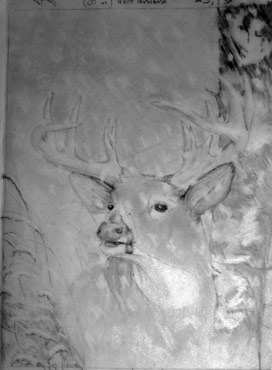 1.)
Here we have a tracing of an old sketch I did about 10 years ago. The
buck is the original. I added a tree, some snow covered wild rye grass,
and an impression of snowfall.
1.)
Here we have a tracing of an old sketch I did about 10 years ago. The
buck is the original. I added a tree, some snow covered wild rye grass,
and an impression of snowfall.
As you can see, the buck is not quite accurate. His
muzzle is too "squashed", and his near eye seems too high.
(Always save your old sketches. Even if your drawing skills have greatly improved, these “doodles from the past” can often prove to be nuggets of inspiration.)
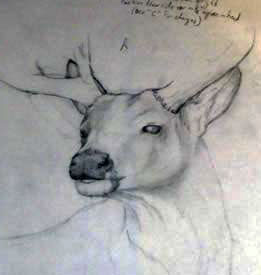 2.)
Here I used another layer of tracing paper to rework the muzzle and
jowl. I also decided to bring the ears more upright and refine the shape
of the skull where the antlers protrude.
2.)
Here I used another layer of tracing paper to rework the muzzle and
jowl. I also decided to bring the ears more upright and refine the shape
of the skull where the antlers protrude.
The near eye looks better, but I still don't
like the far eye and the angle of the antlers isn't quite right either.
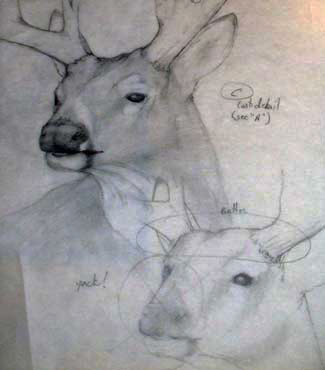 3.) Another layer of tracing paper and I now have
antlers that feel right. You'll see that I also set the far ear a bit
more upright.
3.) Another layer of tracing paper and I now have
antlers that feel right. You'll see that I also set the far ear a bit
more upright.
I still had trouble with that far eye; however, when I went
back to its former placement, the new antlers proved to be the only change
needed.
Now to start on the painting…
I transferred the background from step 1, followed
by this head sketch,to my pastel board. Then I transferred the antlers
and far eye from the previous sketch,lining them up in their final places…
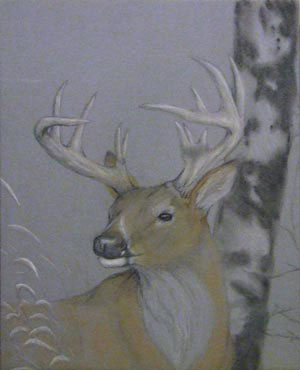 4.) Here we have the final layout. I roughed out
the color scheme and light source using charcoal and soft pastels. I maintained
a moderate level of detail to help lock the final painting in my mind.
4.) Here we have the final layout. I roughed out
the color scheme and light source using charcoal and soft pastels. I maintained
a moderate level of detail to help lock the final painting in my mind.
I lightly sprayed all this with three thin coats of
fixative so it would not blend with my paints. I wanted to have this only
as a color map while I lay in the background.
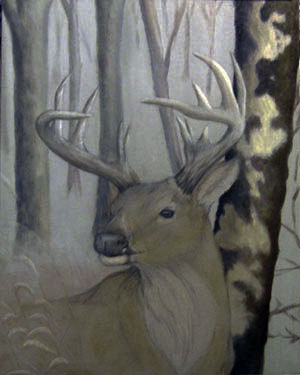 5.) Here we have the first layers of translucent
oil paint washes. I started by roughing in the farthest trees. This was
over-laid with a zinc-white/cobalt wash to soften the colors and build
atmosphere. I repeated the process with some “closer” trees,
and then the mid-ground trees. The entire background was given the zinc/cobalt
wash at each stage, increasing the feeling of depth by building increasing
layers of the wash over the preceding “tree layers”.
5.) Here we have the first layers of translucent
oil paint washes. I started by roughing in the farthest trees. This was
over-laid with a zinc-white/cobalt wash to soften the colors and build
atmosphere. I repeated the process with some “closer” trees,
and then the mid-ground trees. The entire background was given the zinc/cobalt
wash at each stage, increasing the feeling of depth by building increasing
layers of the wash over the preceding “tree layers”.
I also began mapping the bark of the foreground tree-trunk.
A damp #3 round sable was used to “clean” the antlers and
ears enough so as not to completely lose their positions.
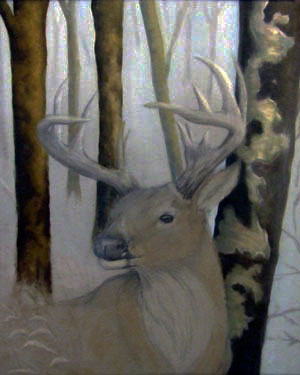
6.) Now that I’m ready to add some “serious”
color, I’ve gone ahead and strengthened the mid-ground and begun
adding more texture to the foreground trunk.
Unfortunately, I’ve made the mid-ground too warm
for the winter scene I’m aiming for. I’ll correct this with
another wash or two of zinc-white/cobalt.
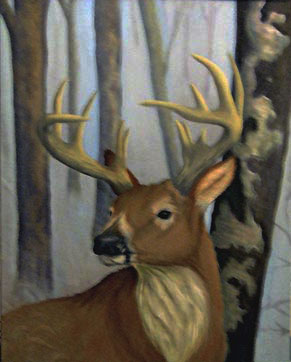 7.)
It took three layers of the cobalt/zinc white wash to tone down those
trees. In order to preserve the rest of the background, the wash was only
applied to the trees.
7.)
It took three layers of the cobalt/zinc white wash to tone down those
trees. In order to preserve the rest of the background, the wash was only
applied to the trees.
Then I went and starting blocking in the shadows and
highlights on the buck using my preliminary color choices. The fur
and antler textures are only hinted at so far.
They will be strengthened as I add more layers of color,
but first I will block in the wild rye grass at the bottom left. This
will give me a better idea of how much detail I need in the fur along
the back, as some of it will show through the grass.
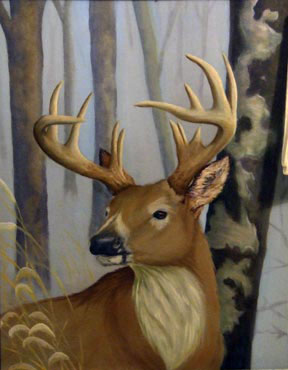 8.)So
here I've done a wash to re-plot the composition of grass. Next I started
finalizing the antlers and ears.
8.)So
here I've done a wash to re-plot the composition of grass. Next I started
finalizing the antlers and ears.
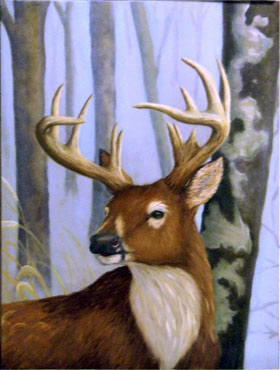 9.)Next,
I went on to finalize the fur for the whole buck. This was done wet-on-wet,
meaning I worked back and forth with all the different colors without allowing
the paint to dry. This creates a natural blending and blurring of the colors,
keeping a soft look to the fur. This is very important, since you can't
see each individual hair, even though your mind tricks you into thinking
you do. If I painted each hair with destinct clarity, the illusion of real
fur would be broken.
9.)Next,
I went on to finalize the fur for the whole buck. This was done wet-on-wet,
meaning I worked back and forth with all the different colors without allowing
the paint to dry. This creates a natural blending and blurring of the colors,
keeping a soft look to the fur. This is very important, since you can't
see each individual hair, even though your mind tricks you into thinking
you do. If I painted each hair with destinct clarity, the illusion of real
fur would be broken.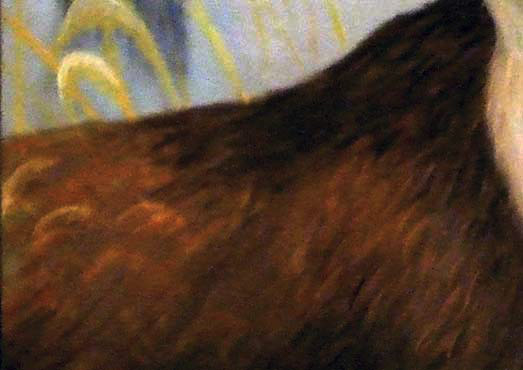
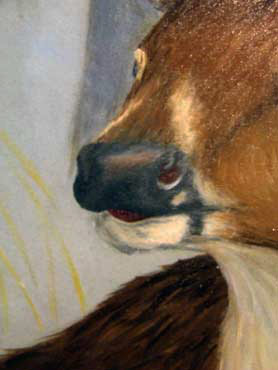
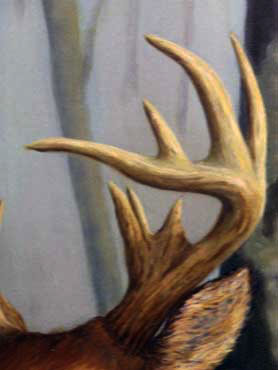
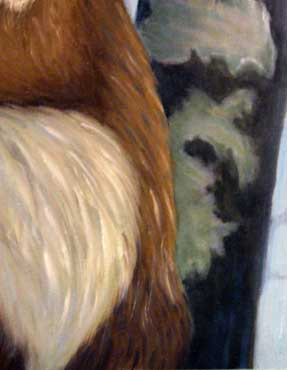
10.)This photo and the next three are detail shots from step 9. These are for you to study in order to get a better idea of how I built up the fur. Take special note of the fact that I did not use pure titatium white anywhere in the fur around the eyes, muzzle and throat. Using pure white has a tendency to flatten your painting, so use care with where you use it and how much. About the only time I use pure white is when I wish to make a reflection really pop, which is limited to snow, glass and metalic objects under a strong light source.
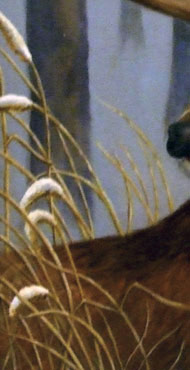 11.)
Lastly, I've completed the detail on the rye grass. This was done with
the wet-on-wet technique using a 5/0 liner brush and a 10/0 short round
detail brush.I started by using burnt umber for the shadows, followed
by a mix of yellow ochre with a little raw sienna, and finally white tinted
with yellow ochre. The snow was zinc white with a touch of ultramarine
blue, topped by zinc white tinted with yellow ochre and cadmium yellow
medium. I worked from front to back, painting each stalk fully before
overlapping them with the stalks in front. This ensured that each stalk
"flowed" along its entire length, otherwise they might have
looked disjointed.
11.)
Lastly, I've completed the detail on the rye grass. This was done with
the wet-on-wet technique using a 5/0 liner brush and a 10/0 short round
detail brush.I started by using burnt umber for the shadows, followed
by a mix of yellow ochre with a little raw sienna, and finally white tinted
with yellow ochre. The snow was zinc white with a touch of ultramarine
blue, topped by zinc white tinted with yellow ochre and cadmium yellow
medium. I worked from front to back, painting each stalk fully before
overlapping them with the stalks in front. This ensured that each stalk
"flowed" along its entire length, otherwise they might have
looked disjointed.
I used a #0 and #3 round brush damp with turpentine as needed to "erase" wayward brush strokes, such as the farthest strands that come up from behind the buck.
 Majestic
Snowfall
Majestic
Snowfall
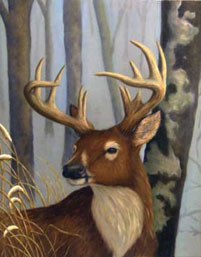
Here is the final version. As the name suggests, there was originally going to be snow falling. However, I'm quite happy with how it looks at this point, so I'm going to leave it as is for now. I will likely play with the photo on the computer to see if it might look better with the snow. If it does, then I'll go back and add it later.
*One final note: don't be afaid to use computers to play around with ideas and composition. It is quite a common practice among painters these days. I think it's most likely because of that magical "undo" button. And remember, what ever you choose to paint, and in what ever style you use, your best works will always be the ones that mean the most to you. Your brush will carry your emotions as surely as it carries your paint.
<All images were modified and saved for optimum web veiwing using Adobe CS3: Photoshop and ImageReady>
Copyright 2008 Heidi Gendron
Last Updated on
April 13, 2008
*All
images and graphics used in this website are created by and property of
Heidi Gendron. Copying and/or using any part of this site for personal
or monitary gain without the written permission of the artist constitutes
fraud and is punishable by law.